Showing posts with label Phnom Penh. Show all posts

Tuesday, January 15, 2008

Day 215 - In Cambodia...

...Tarantulas are not pets. They are a tasty snack fried up with soy sauce and garlic. The bus ride from Phnom Penh to Kratie was eventful only in the snack foods sold at each rest stop. Stop one had the widest selection offering tarantulas, crickets, grasshoppers, silkworm grubs, even what looked like shiny black roaches. I sampled the spiders - surprisingly tasty. They tasted like (and had a texture remarkably similar to) fried softshell crab legs.


...Honda Hero motorbikes are the main set of wheels. Them and Toyota Camrys with souped up suspensions to handle the largely unpaved roads. The little motorbikes zip around on every road serving as family car, cargo truck, and taxi all rolled into one.

...The river has dolphins in it. The Mekong is one of the last remaining places where Irrawaddy river dolphins survive in the wild. They went extinct in China in 2006 or 7. There are only about 75-100 left in the Mekong, and about half of those live around Kratie. We took a boat out to see them, and actually got quite close. Unfortunately for the pictures, they are quite fast, usually disappearing with a splash right about the time the camera clicks. That grey 'log' in the left part of the frame is actually a 6' dolphin peering at the boat.

...Children think swatting each other with flowers is a fine game.

...Red sunsets spill across the Mekong as fishing boats and ferries slowly chug towards home.

Monday, January 14, 2008

Day 214 - Monuments and Museums

Today we decided to experience the brighter side of Phnom Penh. We started the day at the symbol of the city, Wat Phnom. Legend has it that a lady named Penh found 4 Buddhas washed up on the banks of the Mekong, and housed them on a hill near where she found them. The town the grew up around that hill became Phnom Penh - literally, The Hill of Penh.

Today, a simple Wat and a few stupas adorn the 27m high hill. One stupa also seemed to be home to a friendly butterfly that fluttered around and around the point, landing occasionaly nearby, and once even on my shoulder. The wat itself is very popular with students who come to pray for good grades on their exams. If they do get good marks, they return to make offerings of banannas and flowers. The offerings are much appreciated by the troupe of plump monkeys that gambol around the hill.
The hill is also home to many entrepeneurial vendors selling everything from incence for the Buddha to pickled mangos, to small birds. One purchases a bird to free it from its cage, but word has it that the birds are trained to return to the cages after liberation. Also abundant on the hill are the naked children of the vendors. They squeal, run about, and spray each other with the hoses intended to water the trees and grass of the monuments. Very cute.
From Wat Phnom, we opted to walk down the waterfront to the Royal Palace and National Museum. The riverfront is a bustling center with upmarket hotels, retaurants, and vestiges of French colonial architecture.
Wat Ounalum is tucked discreetly between the shopping area and the National Museum/Royal Palace complex. During the Khmer Rouge all of its Buddhas were therown in the Mekong or smashed. In the eighties, they were hauled out and restored - go Buddha! Anyway, when we arrived, the place was locked, and we feared that we had stumbled into a private area. Soon though, an old man came around the corner with a ring of keys and unlocked the door. The main Buddha supposedly contains an eyelash of Bhudda himself. We lit incense before that statue, and were blessed with jasmine-infused holy water.
When we arrived at The Royal Palce, it too was locked up tight. Turns out the guards lock up from 11-2 for lunch and siesta. While we decided what to do while we waited, a girl selling water came over to chat with us. She made a very persuasive argument, and we promised to buy a bottle when we returned.
The National Museum is a beautiful building with French Indochine architecture. It houses several sculptures and artifacts from Pre-Angkor Cambodia on. Best of all were the 'room o' Buddhas' and the fishponds in the courtyard. True to form, we were more excited about feeding the fish than about the exhibits.
We finished the museum at almost exactly two, and wandered back over to the now-open palace. Stuck off the end of one building in the courtyard was an incongruous, lacy white building, The Pavilion of Napoleon III. Oh, those wacky French.
The complex's claim to fame is the Silver Pagoda, which is not actually silver at all. It is so named because of its floor of several thousand silver tiles, each weighing over 1kilo. The Khmer Rouge claimed to leave the Royal Palace and Silver Pagoda intact to show their respect for Cambodia's history and culture. That said, much was still stolen or lost during their regime.
When we left the palce grounds, it was late afternoon, and consequently much cooler with nice, slanting light. We walked slowly home on the mercifully logical, gridded streets. Never again will I take for granted logical city planning!
Tommorrow morning, we depart for Kratie, then wilds of Laos. As stated in the update, don't worry if you don't here from us for a while. Computers are thin on the ground up there from what I hear.

Sunday, January 13, 2008

Day 213 - No Place for Old Men

There are few old ladies in Phnom Penh. There are even fewer old men. It is a viceral reminder of the genocide of less than 30 years ago.
This morning we visited Choeng Ek Genocidal Center, better known as The Killing Fields. This the place where more than 10,000 Khmer men, women, and children were executed and thrown into mass graves. Strangely, and like S-21, the area is very peaceful. Grass and flowers have grown over the pits of the excavated graves, and butterflies swarm over the place.

There are more that 300 known 'killing fields' in Cambodia, Choeng Ek is just the most famous because its victims are the best documented, having been the elite of the capital city. Surely there are even more sites that have not been uncovered, let alone documented.
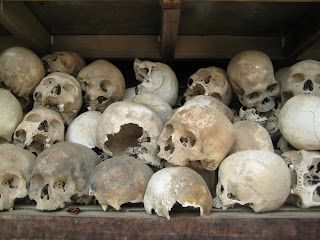
In order to save bullets, victims were usually bludgeoned with bamboo rods, hoes, or other farm implements. Others had their throats cut by machete or were suffocated with plastic bags. Frequently they were merely unconscious when whey were thrown into the pits, and were buried alive. Because the families were told that the people being taken away were being taken for 'reeducation', they did not know that they were being taken for execution until they still hadn't returned many years later. Many burial and execution sites were left undiscovered because they were frequently in remote wooded areas. Choeng Ek was in a forest that had once been a Chinese cemetery. It was only discovered in 1980 because the smell from the shallowly and improperly buried bodies became to strong to ignore.

At least 10,000 bodies were uncovered. In 1988 a memorial was built in their honour. Every time it rains, more clothing and bones rise to the surface. These bones and garments are gathered and attempts are made to give them a respectful resting place, but often they wind up simply piled at the bases of trees. As we walked between rhe excavated pits, bits of clothing scattered the path, and smooth bones showed under a fine layer of dust. Even treading carefully, it was impossible not to avoid stepping on them entirely. Perhaps most disturbing was single human tooth lying in the middle of one of the paths like just another pebble.

When Pol Pot's Khmer Rouge swept through Phnom Penh, it obliterated the educated classes. Besides the immediate impact, it slammed the brakes on Cambodia's development. As of 1980, there were no universities in Cambodia, and only 20 high schools for the entire population. Well into the 80's people were afraid to get an education, because the memories of what had happened to the other educated people were still too fresh. Even had they wished to study, there were no professors with which to staff the universities. To this day, the majority of Cambodians over the age of 25 only have an 8th grade or lower education.

Eventually, professors from France, many of them Cambodians who had been living in in Europe, returned to their home country to rebuild the education system. Today, young Cambodians go to school, frequently through college. Nearly all begin studying English between ages five and seven, as their parents believe it the path to a brighter future. The government encourages students with scholarships to study in Australia, France, and even occasionally the USA.

The country is on the upswing, but there are still major hurdles to its development. Corruption is rife within the government, with personal gain often winning out over public good in the allocation of funds. NGO's are a big business in Cambodia. Certainly they are doing some good in the country, and arguably the country would be much worse off without their support, but the upper level employees enjoy a standard of living higher even than that of most Americans. In a country where the US dollar is worth 4000 of the local currency, it is not hard to imaging how much better off the place would be should those dollars be directed into development programs, rather than bankrolling a five-star lifestyle. Tourism, perhaps the biggest potential source of income for Cambodia - none of her neighbors can boasts ruins of more renown than the temples of Angkor - could be a lifeblood for the country. Unfortunately, most of the national treasures are privately owned, and the bulk of their revenue goes to line the pockets of the corporations and individuals who control them.

It is hard to believe such recent and ongoing political turmoil in such a friendly and apparently peaceful country. The area around Choeng Ek is surrounded by new houses, and lush floodplains where homes on stilts perch to avoid the annual floods. Children wave from doorways, and everyone who speaks English is excited to try conversation with a foreigner.

Perhaps nowhere is the entrepreneurial spirit more evident than at The Russian Market, so called because it is where the Russians went shopping the late 80's. Today it half tourist souvenir junk store, and half working marketplace selling everything from tires to fruits. In between the 'junk stores' and the working market, food and drink vendors dish up meals for pennies. We feasted on noodles and spring rolls, and for 75 cents, left the market with a big bag of Rambutan, one of my favourite fruits that usually cost about $6 per pound at home.

On the way back to our guesthouse, we stopped at an internet cafe to catch up on the blog and e-mails. The larger Cambodian cities are remarkably well 'wired' with far faster and more reliable connections than even India, the supposed IT capitol of the world. This connectivity is a relatively new development. In the 1990's, there were few internet cafes, and these charged up to $10 and hour. Today, there seems to be an internet connection every other block, and cost less than 50 cents and hour.

Back at the the guesthouse, we took a little break to cool off before hiring a tuk-tuk out to the National Museum for sunset. According to my guidebook, the roof of the museum is home to the largest population of bats in a man made structure in the world. We had hoped to witness the spectacle of thousands of bats streaming out of the elegant building. Unfortunately, between the time of my book's publication and our arrival in Cambodia, the director of the museum had put anti-bat measures in place, and the eaves were woefully bat-free. I hope they found a nice new home.

Thwarted, we returned to the guest house where the receptionist was giving an impromptu magic show. She even tried to teach us how to do a few of the simpler tricks...all but one of which proved beyond my capability. Among the audience was an American girl on vacation from teaching English in China. She and two of her friends, also teacher in China, were planning to have dinner at Friends, a training restaurant that both raises money for causes around the city and trains Cambodian street kids in the restaurant and hotel industry. Cz and I had wanted to dine there too during our stay in Cambodia, so we joined up and made a jolly night of it. It sort of blew our food budget for the day (we have gotten very spoiled on 1.50 street eats), but we figured why not splash out a little on a good meal for a good cause.

Saturday, January 12, 2008

Day 212 - Reeducation

We opted for overland to get from Battambang to Phnom Penh, as the water route would mean backtracking to Siem Reap, then taking the express boat across Tonle Sap Lake. In the wet season the express boat is merely uncomfortable. In the dry season, smaller boats make the run, but the same number of tickets are sold as for the larger boats, resulting, predictably, in boats overcrowded to the point of capsize.

The first two thirds of the bus ride were uneventful. The road was paved (a new development in Cambodian overland travel), and the bus reasonably air-conditioned. Unfortunately, about 4 hours into the 6 hour run, the air con froze up. A little cool air still trickled from the vents, but nearly enough to counter the full load of warm bodies crammed inside. The last two hours were pretty sweaty, and not enhanced by the carsick toddler in the row behind us. Luckily he had only eaten banana and rice, so it didn't smell much or go anywhere but on himself and his poor mom's lap.

We expected our arrival in Phnom Penh to feel much like our arrival in Delhi - hot, crowded, hassly, and full of touts. There were some fairly aggressive tuk-tuk drivers, but we were able to negotiate a fair deal to our guest house fairly easily. The guest house proved better than expected, with our own immaculate bathroom, towels, and even air conditioning. I did some laundry, and we basked for a while in our cool cocoon before deciding to walk to the Tuol Sleng Genocide Museum.

The museum is housed in S-21, or Security Office 21 of the Khmer Rouge. In a previous life, it had been a high school. When the Khmer Rouge captured Phnom Penh, they divided the classrooms into cells and interrogation rooms. Even the playground exercise equipment was converted for use as torture devices. The frame of the swing set still stands, which in Khmer Rouge times was a place where prisoners would be hoisted up by their wrists and abused until they lost consciousness. Of the approximately 14,000 people imprisoned there from 1975-1979, only 7 survived. Most of the high-ranking officials have evaded trial and justice in a political and legal morass. More horrifying still are the hundreds of children trained as guards and torturers. Most Cambodians agree not to prosecute these children, believing that had they not become child soldiers, they too would have died, and that have punished themselves enough in their own minds.

Today, S-21 is a strangely peaceful place. When arrived at 4PM, the late afternoon sun slanted through windows and across the courtyard giving the yellow walls a warm glow. Birds twittered in the flowerings trees of the courtyard, and two Khmer children chased each other on bicycles, shrieking and laughing, incongruous sounds to come in through the window of room still containing the iron bed and shackles of its last, doomed inhabitant.

The first building is a stark reminder of the atrocities carried out here. Each classroom contains the bed and shackles of its last resident. A single, mercifully grainy, black and white photo in each room shows that bed and room as they were found, with the broken body of the prisoner still chained in place.

The first floor of the next building contains hundreds of mug shots of victims as they were brought into S21. Entire families were brought in for 'reeducation', from infants to grandparents. In no photo is anyone crying, not even the babies. Everyone stares at the camera with faces registering shock, fear, defiance, confusion -a whole range of emotion, but all contained. Perhaps most striking are the old men and ladies who face the camera with chins up, eyes straight ahead. They perhaps know best what is to come, but somehow manage to preserver their dignity. In another photo, a little boy of about ten pulls away from a guard just visible to the side, cocks his hip, and smirks at the camera with all his youthful bravado. In yet another picture a young woman stares straight ahead with sad eyes, her arms wrapped gently around the new baby sleeping in her lap. Near her picture, a toddler purses her lips and peers coyly out of the frame, looking for all the world like PI (Cz's niece in the Philippines) posing for a family photo. Further down the line, a college-age girl poses in a souvenir t-shirt from Miami Beach, Florida. It is impossible to remember every face, no matter how hard one tries, but as a group, they represent the brightest of Phnom Penh, and the hope for a solid future snuffed out. Individually, they are the mothers, sisters, brothers, fathers, husbands, whole families whose stories will never be known because the Khmer Rouge saw to it that there no one was left to bear witness.

The final group of buildings remain divided into cells. The cells are about 3 feet wide by seven feet long, built with red bricks in former classrooms. The lucky inmates had most a of a window in their cells. The less fortunate received only the barest sliver of daylight. Everyone was chained at the ankle and regularly tortured. Even now, the rooms are dark and musty, and smell faintly of dust and rot.

Other floors of each section contain exhibits dedicated to the memories of those who were interrogated at S21 before being executed at the killing fields. The exhibits range from amateur paintings showing prison life to photos and stories from surviving family members, to shelves of skulls and torture devices.

It is a sobering place, made more so because it is not softened by many years of history. The events of S-21 happened within most of our lifetimes. The Khmer Rouge only fell in 1979. Cambodia was only fully opened to Western visitors in 1996. To this day, there is debate over the extent of the atrocities committed under Pol Pot, and over whether the perpetrators will be or should brought to justice nearly 30 years too late. The US does not have clean hands in the matter. Our involvement in Vietnam, and later carpet bombing and invasion of eastern Cambodia caused hundreds of thousands of civilian deaths directly, and hundreds of thousands more to turn to the Khmer Rouge, who would later execute them. Among the many facts which remain hazy are exact numbers of people killed. The most recent study indicates it is probably 2, but perhaps as much as 3 million. In a small country of 14 million, that potentially represents nearly quarter of the population.

I am amazed that the events here do not get more press. In school, we all read The Diary of Anne Frank and learn about the Nazi's, but of SE Asia, most of us only learn about Vietnam with a glancing look at Pol Pot. No one seems to want to hear the stories of families fleeing into Thailand across mine-infested forests, or of children forced to work as executioners. Perhaps we hear less about them because in this case we were not the liberating heroes, as we were in Europe. Perhaps, even more cynically, we do not hear about it because the victims were not white people in a place where Westerners regularly visit. Perhaps it is a case of history already repeating itself in Africa and the Middle East. We failed the first time we got involved, and we are continuing to fail around the world. Rather than face the embarrassment, perhaps the West is preferring to simply sweep events under the rug. I know too little of world politics to offer anything more than observation. I have nothing to offer in the way of opinion of what we could or should do beyond that observation. Perhaps it is enough to bear witness, to tell stories. It is impossible for any one person or country to save the world, and arrogant to try. It is, however, I think the responsibility of each individual to try to make it a little better. And by doing that, perhaps it can be saved.