Showing posts with label cathedral. Show all posts

Monday, February 11, 2008

Day 242 - Never Put off 'til Tomorrow...

What you can do today. Because the 14th century monument you were planning to photograph might burn down in the night. Really. We had planned to take pictures of the Namdaemun Gate last night, but decided to wait until today to get both a day and a night shot. When we arrived at the hostel last night however, the entire staff was gathered around the TV watching in shock as Seoul's national treasure #1, the oldest wooden structure in the city, went up in flames. Arson is suspected. Our photo opportunity turned to ashes. Literally.

The gate stood in the heart of the business district, which could easily be mistaken for Manhattan with soaring skyscrapers standing sentry over hoardes of people all carfully choreographed by the traffic lights. We arrived right before lunchtime, and floatillas of businessmen in nearly identical suits flocked to and from the ruins on their way to lunch. It was sort of surreal.

From there, it was a little walk to the Seoul Museum of Art, which according to my guidebook, was the only museum open on Mondays. My guidebook was wrong. It was deciededly closed.

So we walked back to Namdaemun, whose market supposedly boasted a store with 2 floors of toys. Head filled with visions of Gundam, PSP's, and Transformer's, Cz really wanted to pay a visit. It too proved dissapointing, occupying only 1 floor, and containing only a few shelves of Gundam, though the market itself was pretty impressive.

Undaunted, we headed out to the (hard to find) Myong Dong Cathedral, oldest Catholic church in Korea, and known for its neogothic architecture. It was under renovation. Behind screens. At least the inside was open.

Seoul has a kimchi museum in the Coex Mall (where we spent day 1). It was closed then for the Lunar New Year. Turns out it's closed Mondays too.

By now I was so frustrated with spending my last full day in Korea travelling from burned, closed, and under renovation attractions that I was ready to hit someone. So we went to the Coex arcade and blew up a legion of zombies. That made me feel better.

Then we went to 63 Tower, Seoul's tallest building. The Imax was already closed, but the aquarium and skydeck, with views of the city were both open. In addition to the fishes, the aquarium was also home to a flock of penguins (who did not tapdance), seals, sea lions, and a friendly sea turtle.

One touch tank consisted of the standard starfish and hermit crabs, but another was populated by 'Dr fish', small fishes that feed on dead skin. Plexi boxes with finger holes invited a feeding frenzy on anyone who dunked winter-chapped fingertips. The little fish mouths tickled fiercely, and kind of gave Cz the heeby-jeebies, but he held out long enough for a picture.

A feature of every Asian aquarium seems to be the beautifully lit jellyfish display. This one was no exception with luminious jellies of every colour floating in their individual tanks.

After the aquarium, we rode the glass elevator up to the 62nd floor observation deck. Elevators make me nervous to begin with. This one had the added fear factor of being able to see all. the. way. down. All 600+ feet of it. Once on the skydeck, the walls of windows provided 360 degree views over the city of Seoul and the Han river, lit up like a Christmas Tree. There was also a section with a glass floor so one could look past one's feet all the way to the ground, some 62 stories below. It was terrifying. I did it twice. We finished out the trip with nachos overlooking the lights of the city.

It almost redeemed the rest of the day.

Saturday, December 1, 2007

Day 170 - Fishers

We woke up at a ridiculous hour this morning in order to catch sunrise over the Bay of Bengal. As we walked down the beach snarling at the clouds, we were 'adopted' by three stray dogs. Tigger and Ms Robinson are very lucky that US customs frowns on bringing home new pets from abroad. Luckily, the clouds parted in time, and just enough for a gorgeous sunrise.

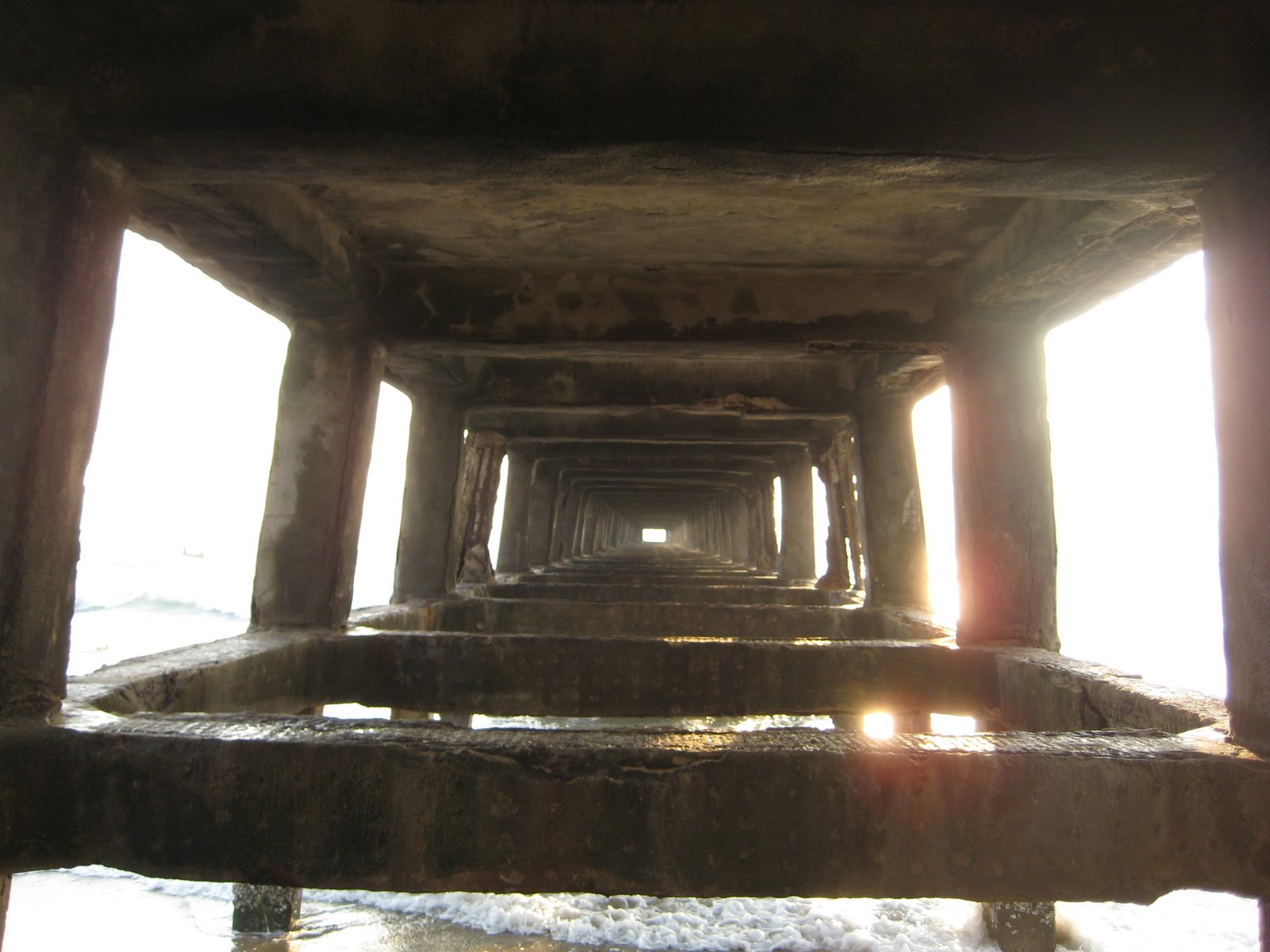
We watched the sun from shore for a while, then went under the large pier to watch the fishermen haul in their boats. Or at least I went to watch the fishermen - Cz was fascinated with the structure of the pier itself.

The 'boats' which the fisherman were hauling in were really more like rafts. Each one consisted of four to six large planks lashed together with rope, and controlled by anything from a plank of wood held like a paddle to long poles. They did not appear seaworthy in the least, yet boat after boat rolled in, each with nets or baskets on board. As each boat floated in, it was hauled up the beach, and the nets offloaded. Then the fisherman (two per boat) would pass the net between them and take out the fish and crabs caught there. Many crows, and even a mongoose watched the proceedings with marked interest. As soon as the fish were clear of the net (and sometimes before) well-dressed men came down to the shore to haggle over the choicest catch. One lucky fellow went home with his bicycle bag bulging full of prawns, crabs, fish, and whelk. There is probably a bouillabaisse in his future.

On the way back from the fishing beach, we stopped for a light breakfast - green coconut from a street vendor. All over the south of India men with handcarts or bicycles laden with coconuts park on the roadsides. For anywhere between five and fifteen rupees, they will hack off the top of the coconut and toss in a straw. Once you have finished the water, they will take their machete, lop the coconut in half, and and hack off a small piece of hull to scoop out the pulp.

Despite the reviving effects of the coconut, our early morning walk took the steam out of us. We popped back into bed for a nice nap before heading out for a day of sightseeing.

We began by walking over to the Botanical Garden. Back when it was a colony, Pondi was divided into a French side, and and Indian side. To this day, there is a marked difference in the volume between the two sides - cross the canal from French Pondi into Indian Pondi, and the volume goes up decibels. The Gardens are on the Indian side, and yet are very quiet. It's sort of interesting to chart the noise levels from the medium-loud French side to the very loud Indian side, and through the garden gates into the quiet green.

Just inside the garden gates lies Pondi's 'aquarium'. It is a small building with clean aquariums. Most of the fish are ones commonly found in your neighborhood pet store - goldfish, gouramis, angelfish, etc, but there was one enormous polka-dotted morey eel and some very impressive anemones as well.

Outside the aquarium we wandered a bit, and stumbled across some tiny train tracks. In a few minutes, a proportionally tiny train came rolling along those tracks. Cz whipped out his camera to take a picture, and discovered that he had left the batteries in our hotel room. With no small amount of grumbling, we hopped into a tuk-tuk and retrieved the battery.

We walked back to Rendezvous, where had dinner last night, and consoled ourselves with large amounts of seafood. From Rendezvous, it was a short walk back to the Garden, were we not only got a picture of the toy train, but even rode it around the park.

The road near the Botanical Garden loops around the whole of Pondi. We decided to follow it around to another landmark church. This one built in the Gothic style, but with a distinctly Indian paint job. From the church, the road continued back to the beach where a brisk wind was making whitecaps on the water. Cz was feeling particularly stylish in his 'man dress' (Kurta), so I was able to convince him to let me take his picture.

We spent the rest of the afternoon reading, napping and admiring the huge bougainvillea shading our room. Around dusk, we decided to take a another little walk, and to visit the internet cafe. The road to the internet cafe passes by the church we visited yesterday. Today ALL the lights were lit, and a statue of Virgin Mary was being paraded around the courtyard on a neon and Christmas light lit, flower-bedecked palanquin. I do love Indian Catholicism.


Friday, November 30, 2007

Day 169 - French Ganesh

Pondicherry was a French colony. The Dutch managed to dig their claws into it for a few years in the 18th century, but the French were emphatic in their non, non, non, and reclaimed it within a few years. Though Goa has a reputation for being the most European of Indian states, I believe Pondi takes that gateau.

The streets here - pardon moi Les Rues - are generally wide, clean and leafy. Even more exciting, they are on a logical grid and most of them have their names actually posted. As in on visible street signs! These are the first street signs we have seen in all of India (and Nepal too for that matter). Until you have spent three months sans labeled streets, you have no idea the joy of being able to navigate with ease.

Pondi is a tiny city right on the Bay of Bengal. Once we got over the excitement of labeled streets, we spent a good amount of time meandering up and down the beach. In our meanderings, we stumbled across multiple war memorials living right alongside a monument to Ghandi.

As a French colony, Pondi is a foodie's delight. The cuisine is a mix of Indian and French with loads of fresh seafood directly from the Bay. We ate lunch at Madame ___. One wall was decorated with a Rajasthani Poster, the other with Tissot print. The lamps were Indian Mirrorwork, but set between tables with decidedly French gingham tablecloths and roses in white china vases. Being so close to the water, seafood is also incredibly cheap. We plan to eat our weight in fish and prawns.

Perhaps because of the European influence, religion is less visible in Pondi than in other cities in India. That said, where it occurs, it is done in fabulous style. One small temple that lies down a quiet street is dedicated to Ganesh. Ganesh, for those of you who don't know, is the elephant-headed god. And what better to have outside a Ganesh temple than a friendly elephant? For a few rupees, one can buy him bundles of grass and guavas, and in return for the treats, he taps one's forehead in blessing. Even if you don't buy him treats, he is likely to snuffle over you with his trunk - much to the squealing delight of the school groups who come to see the paintings in the temple itself.

Pondi, like Goa, houses a mix of Hindus, Muslims, and Christians. As in Goa, the Catholic churches are confections of colour and even neon. BY day, The Church of the Immaculate Conception looks like a pretty standard gold and white baroque church. By night though, the square is floodlit, a red neon cross graces the roof, and Mary floats on a neon moon surrounded by twinkling stars. The front of the building is also festooned with Christmas lights, though today they were not turned on.

Overall, Pondi is a lovely, clean, surprisingly European respite from the hurly-burly that is much of the rest of India. My guidebook says that most people stay longer than they intend to in Pondi. We are no exception. Because it is a small city, we had considered spending only one day here, but have decided to stay for tomorrow too.


Monday, November 26, 2007

Day 165 - Inverse Proportions

We futsed and puttered away a good bit of the morning deciding what to do. We finally settled on taking the bus to Mysore, a nice city in theory only 2.5-3 hours from Bangalore. With traffic it was nearly 4 hours. When we arrived, we discovered that the main attraction, the City Palace, was closed to set up for a festival. As M says, "It's like the Fourth of July every friggin' day here!" Undaunted, we made our way to St Philomena Cathedral, which was lovely, though not "full of birdsong" as the guidebook promised. I guess people got tired of bird poop in the pews and put nets across the doors.

We did find the small sign and arrow indicating the way to the crypts which were satifactorily dim and eerie, complete with a polychrome Jesus lying in one hallway and St Philomena watching over a blue-painted well into which donations could be flipped with a certain degree of irreverency. Interesting, very few names in the crypt were Indian. I guess when the church was still taking bodies it was strictly Anglican territory.

On the way out of the church we passed a fruit vendor, and treated ourselves to the sweetest pineapple ever. We couldn't finish it, much to the delight of the cows who got the leftovers.

By then it was nearly 5, so we moseyed our way back to the bus stand. Where it took another 4 hours to get home.

So. 8 hours of bus. 2 hours of touring. Still worth it.

Wednesday, November 21, 2007

Day 160 - Melting Pot

Our day began with breakfast by Mama. And by breakfast, I mean a feast of egg and peas curry, fresh papaya, tea, and pappams or maybe apams. I still haven't figured out what they're called, but if a fluffy American pancake and a French crepe had a baby made out of rice flour, this would be it. The middle part is thick and soft, with lacy, crispy edges. We didn't tuck in fast enough, so Mama thought we wouldn't properly experience crispy edges. Her response - to cook two more and insist that we eat them right now. Which made a total of ten pancakes between us. It's like being back in Germany.

Somehow we did manage to roll ourselves into town. Kochi has been a trading center since 72AD. As such, it has always been a relatively wealthy and influential city. Read: much desired by colonists of every variety. On our wanderings, we passed an overturned tree with signboards indicating 'the roots of Kochi'. Pretty much everyone who's anyone has ruled this little plot of land at least once.

Currently, the most visible histories in town are Portuguese, Dutch, and Jewish. Who would have thunk that one of the oldest Jewish communities in the world would be in Southern India? Jews established trade routes with the Malabar coast sometime in the 1st century BC trading frankincense, gold, and myrrh for spices, ivory, and peacocks. In 72AD when the Romans(?) destroyed the Temples and Cities and the Jews were forced to flee, a contingent landed in India north of current Kochi. In the 16th century, when the Portuguese burned that city, the Jews moved a few KM south to Kochi, where a small community survives to this day. The current synagogue in Kochi was built in the 16th or 17th century, though one stone is from the original synagogue built in 72AD! Jew Town, the area around the synagogue has been a trade center (primarily spices) since the first families arrived in 72. And while many of the businesses now have owners with Keralan names, there are some with Jewish names that have been in the same family since that first landing.

Closer to our guesthouse are two Christian churches. The church of St Francis was originally Portuguese, was bombed, rebuilt and claimed by the Dutch in the 17th century, then by the Anglicans in the 18th. It is now Indian. Read up on the history of St Francis church, and it pretty much sums up the political history of the southern half of the country. St Francis' claim to fame is that Vasco De Gama was buried here for 14 years before being shipped back to Portugal. Basilica Maria de la Luz was also originally a 16th century Portuguese Catholic church. From the outside, it retains its somewhat reserved, European countenance. Step inside though, and it's all Indian Catholicism - Polychrome carvings, angels, Jesus lit up in neon - Vegas has nothing on Indian Catholics.

Near the two churches, a short walk down the seawall, lies the Dutch cemetery. It's old and overgrown, but very quiet. According to my guidebook, "All of the crypts have been opened by grave-robbers, and some show signs of being occupied, all the more reason not to visit after dark." The cemetery must have been cleaned up since the book was written, as all the tombs were tightly sealed. We did find an enormous chicken foot - nails and all - curled up on the edge of one crypt though, and some feathers scattered on another...I'm thinking that this chicken did not die of natural causes...

By now we managed to walk of Mama's breakfast, and ate a delicious seafood dinner at a streetside restaurant. While we were eating, a kite (sort of like an osprey) landed on a perch nearby. Apparently he visited the tree near the restaurant for so long that the owners built him a perch near the kitchen where he gets the fish scraps.

After dinner, we watched the last of the sunset of the Chinese fishing nets, and went to a concert of traditional Indian music. As stated before, Kerala (the state which contains Kochi) has been occupied by pretty much everyone at one point or another. In each occupation they have taken the best of that culture and integrated it into their own. Hence, a European violin featuring in a night of traditional Indian ragas.

Monday, September 10, 2007

Day 88 - VISAS!

It was one of our last stops of the day, but I know a lot of you have been worried so here it is at the top of the post. We got our visas for India. According to the dates printed on them, they were already ready on Friday. The talley - One day spent trying to change flights, some hours spent in the Embassy, a bit of stress. The lessons learned - Jess version: It´s relatively easy to pick up a visa on the road. The Cz version: Know all countries´ visa requirements WAY in advance to avoid panic. I suppose a combination of the two will serve us well along the way.

As for the rest of the day, we spent the morning at Schloss Shönbrun. We played real tourist, and took a headset tour of the palace interior. It was interesting to hear the history of the rooms and he people behind them, though I could not begin to tell you who belongs to which generation. Empress Elizabeth, the wife of Franz Joseph, is the most popular figure, but my personal favourites were the portaits of Maria Antoinette, later Mrs Louis XVI, as a child. It was interesting to see the childhood portraits juxtaposed against the history of royal marraiges. From cradle to grave, these children were political pawns. One of Marie Antoinette´s sisters, Maria Christine, was said to be the favourite of her parents because she was the only daughter allowed to marry for love, but I wonder if it wasn´t that she was the favourite, but simply that she had less political capital than her sisters and brothers.

Outside the palace building, formal gardens spread in every direction. We went into the privy garden and admired the flowers from the viewing terrace. The garden also featured some luscious looking lemon trees. We (or at least I) was seriously tempted to snag some fruit, but the guards probably would have frowned on that.

Equally fun, and far more legal were the boxwood labrynth and maze games. The labrynth was sufficiently tall and thick to be confusing, but not too challenging. The maze games were set up in a second labrynth with much lower bushes, and therefore much easier paths. A central fountain operated by means of a rocking board - balance for a split second, and a jet of water shoots up. A cluster of mirrors created a kaleidescope view of the garden, and a series of tiles set in the ground played the "dance glockenspiel". A precourser to "Dance Dance Revolution" perhaps?

After the mazes and games, we wound our way back up to the Gloriette for a cup of coffee. Our pass to the palace and gardens came with a coupon book, including free chocolate with our espressos.

We had wanted to also visite the zoo, but it was already after 2PM, so we opted instead to head out to Karlskirche. Karlskirche is a large Baroque church. Here too we went touristy and got the information handsets. They turned out to be very informative. Among other things, we learned that the church was build specifically because Vienna was in the throes of a second round of the plague in the middle of the 18th century. St Charles Borromeo had been a significant figure during the first round. It was hoped that by building a church to his honour, he would intercede on Vienna´s behalf for this round.

It´s strange how such a cheerfuly round-shaped and brightly coloured church should have such a dark story. Sort of like how even tragic operas from that time all seem somehow bouncy and written in a major key.

The church is currently undergoing restoration works. Rather than apologise for the scaffolding, the management has put in an elevator system, and opened some of the scaffolding for tourist viewing. It wobbles, as scaffolding is wont to do, and it is very, very high up. There are even steps up into the lantern for views out over the city and down, down into the depths of the church. The result is a mix of terror of falling and dying, and of pleasure at being able to look at the frescos close up. As we were looking, my ears perked up at another tourist saying "St Jacob" and "scallop shell". Lo and behold, up in the dom of the Karlskirche is our old friend, a Perigrino of St James.

Karlskirche is in the vicinity of the Nachstmarkt, a consistant reccomendation from our assorted friends and family. We meandered past the retaurants and through the assorted stalls, stopping to buy a back of wasabi-covered peanuts for an afternoon nosh. Interestingly enough many of the stalls were selling Indian spices, and the colours and smells made us excited about our next leg.

From Nachstmarkt, we walked to the Secession House, a landmark of Jugensteil architecture, and a museum of the Vienna Secession. Unfortunately, it was closed because today was Monday, but even the outside was pretty neat.

By then it was 5PM, and we had a date at the Indian Embassy. You can see how that went at the top of the post. Short version: We are cleared for landing in the Subcontinent.

With that off our minds, we celebrated by...

blogging.

Wednesday, September 5, 2007

Day 83 - Cheap Thrills

We spent a good bit of the morning on line at the Indian Embassy. Once through the line though, the paperwork was relatively simple (two short forms, 86 Euro each, and 2 passport photos). In theory we will have visas at 5PM Monday.

Vienna is a beautiful city. By the time we left the embassy, it was nearly noon, but we spent a little while wandering in the city center oggling buildings. Yesterday we passed by St. Stephens on the outside. Today we went in and looked around the interior. We happened upon an english-speaking tour, and tagged along for as much of as we felt we could without getting caught. The tourguide was very good, and we learned all sorts of interesting symbolism and history about the cathedral. For example, the most famous bell in St. Stephens is made from the bronze of Turkish cannons. During the Ottoman Empire, when Austria defeated cities in Turkey, they would melt down the cannons to make church bells. So a little piece of Istanbul has followed us here!

After visiting St Stephens, we made our way over to Museums Quartier. Museums Quartier is a few city blocks occupied, as ther name implies, entirely by museums. Today we visited the Leopold Museum. It was four floors of early 20th century and late 19th century art, most famously several works by Koloman Moser, Gustav Klimt and Egon Scheile (alot on the Viennese Secession and Wiener Werkstatte). We spent so much energy there that we didn't feel up to visiting another museum. Instead, we walked across the street to the opera house to enquire after a tour (already booked up and way too crowded, another day perhaps) and tickets.

It turns out the Staatsoper has standing room tickets for 2 Euro. They go on sale 80 minutes before the performances, and there are usually plenty available. We are huge theatre and opera buffs and could not believe our good fortune. Granted, the places are way up in the back of the balcony, and it is not allowed to move down into empty seats, but the sightlines aren't all that bad, and the sound quality at that hieght is among the best in the house. There are shows every evening. Tonight we went to Verdi's Simon Boccanegra. Tomorrow is Carmen. Friday and Saturday we will be in Eggenburg, but on Sunday we are going to see Die Zauberflaute. For two Euro a ticket, we can afford opera every night even on our starving artist budget!

If you look really closely on the drop, you can spot the Incredible Hulk by the top right corner...not associated with the design of the show, but hopefully if we take the tour we will get more info on the very unorthodox drop for such a prestigious opera house.

In a way it is good that we are stranded here until Wednesday. There is no way we could have seen and done enough in the two days we had originally planned. We will be so steeped in European culture by the end of this week, I think we will be more ready to face the unknowns of India and beyond!

Tuesday, September 4, 2007

Day 82 - Unlisted Holiday

Last night we debated wheter or not to go to bed at all. Reason: Today we had to be up at three in order catch the shuttle to airport for our 7:45 flight to Vienna. We have learned to pack our water filters where they are accessible. Apparently they look like very suspicious large batteries in the x-ray machine. Thank goodness we kept the all instructions and original pamphlets with them, as even visual inspection by the officials and our explanations are often not enough. At nearly every security checkpoint they are taken out and examined, and the accompanying papers read from cover to cover.

All went smoothly until we were on the plane. Whereupon we sat in the plane, at the gate for almost 45 minutes. Then we rolled a little way onto the tarmac. And waited some more. A kid a few rows up from us cried so hysterically that he made himself vomit. This was not an auspicious beginning. It was urgent that we arrive in Vienna on time because the Indian Embassy only take visa applications from 9:30-11:30 AM. We were scheduled to arrive there at 8:55. Allowing an hour for customs and travel from the airport, we had planned to be at the emabassy by 9:55.

At 8:45 I looked at my watch and told Cz that if we left this instant we might still have a chance. Five minutes later we were airborne. The flight was uneventful, and we arrived in Vienna at 9:55. There was a man checking passports as we deplaned. Anyone with a red passport (Turkish) had it opened and checked. We ony had to flash our blue passport to be waved through to the terminal. Unfair I know, but under the circumstances I was grateful. We breezed through the real passport control desks and customs without a hitch. At the terminal entrance, someone was handing out city maps. There were huge, well-marked signs for the express train to the city center. We ran to the train, hopped on, and found the address of the Indian Embassy. We were there with 15 minutes to spare!

It was CLOSED.

For a holiday. For a holiday that the man I had asked on the phone if it would be open didn't know about. We made it with much rushing and with time to spare and it was closed. After the requisite snarling, we headed off to find our hostel.

After a little searching, which happened to take us past St Stephens Dom, we found our way home. It was a very cute place in a converted apartment, convienient to everything. We spent the rest of the afternoon catching up on the blog, contacting friends around the city, and mailing a gift and postcards back to the states. By the time that ws finished, we stopped at the grocery and picked up some groceries.

Little did we know the kitchen only had a microwave. We persevered, and managed to produce a perfectly repectable dinner of pasta and salad. Just in case you were wondering. Here is how to cook spagetti in a microwave.

With the Microwave on high
1. Bring the desired amount of water to a boil.
2. Add the pasta
3. Cook. It will take a total of about 15 minutes after you add the pasta. Stir every 5 minutes or so for even cooking and to prevent baking your pasta to the sides of said bowl.
4. Drain. Add sauce as desired.

We are masters of improvisation here. Tomorrow we have another go at the embassy. Wish us luck!

Saturday, September 1, 2007

Day 79 - Istanbul or Constantinople

Travel issues under control-ish, today we devoted almost entirely to being tourists. As stated, Aussie Girl and we share many common interests, including what we would like to visit in in Istanbul. We met up in the morning, and were soon joined by her pal, Aussie Boy, whom she met on the plane and was staying at a different hostel.

Our first stop was unplanned. We were walking towards Haggia Sophia when a bride crossed out path. Then another. And another. And another. A busfull (literally) of brides descended and made a slow circuit of the courtyard, having their photos taken by tourists and wedding guests alike. They were also applauded and cheered by wedding guests and tourists alike, which is as it should be, under the circumstances.

Yesterday, I saw a man with a silver pot on his back in the courtyard. I had no change to buy a glass of whatever was in the pot, so I felt that I couldn't take a picture. He was there again today, and was well aware of his photographic appeal, calling out "Photo, Photo" rather than "Juice, Juice". Even so, he proved a jovial old man, laughing frequently and showing more gums than yellowed theeth. Our photo is well worht the price of a cup of slightly warm cherry juice.

We finally managed to take ourselves into Haggia Sophia. It was first destroyed in 537, and quickly rebuilt. The original building date wasn't given, but if it was first destroyed in the 6th century, one would assume it is circa really old. It is a stunning piece of architecture - domes and arches covered in mosaic, paint and carving looping up and up almost out of the eyes' reach. The carving on the capitals and screens is so delicate, the stone almost looks like lace. The tiles for the mosaics, gold, and silver, and coloured stone are tiny - thumbnail sized - and every single one, even for the solid background colour fields is carefully placed in arches and turms like the whorls of sunflower seeds.

More breathtaking that the shape of the place is its history. Haggia Sophia was originally built as a Catholic church. Over the centuries it has flipped back forth between Mosque and Cathedral. The presence of time and change fills the space between floor and dome, granting even the air molecules a weight of their own.

It is possible to climb the ramps up to the level of the first gallery. The gallery is quite high, but still the central dome soars well above it. The main treat on the gallery level are the views out over the city. Small windows - would they still be clerestory? - look out in every direction to visitas of rooftops, sea, and the Blue Mosque. The windows are set high in the wall, and Aussie Girl and I had to really stretch to see, but it was well worth it.

From Haggia Sophia, we crossed over to the Blue Mosque. Unfortunately we had all forgotten about the strict dress code, and therefore could not enter. We arrived near the call to prayer (so even if we had been appropriately dressed we could not have gone in). Every mosque, including the Blue is equipped with loud speakers to send the prayers out over the city. The time for each is slightly staggered from the other, so it almost sounds like an echo of song traveling from one end of Istanbul to the other. To my ears it is very foreign - this is one of the first moments on the trip that I have truely felt myself in a foreign land. The rest Europe was different than home, but different is different from foreign.

Thwarted in our attempt to visit the mosque, we (Aussie Girl Aussie Boy, Cz and I) hopped on a tram to see if we could catch the commuter ferry along the Bosphorus. No dice, but we were near the Galata Bridge and Galata Tower (both quite famous), so we decided to have a little stroll over the bridge and up to the tower. The bridge practically bristles with fishing poles and fishermen. On either end of it, a jumble of modern and ancient buildings, shanty roofs, and Mosques pile up the hillsides. Near the bridge, there were a host more stalls selling all manner of "street meat". In one stall a man was throwing mackerel fillets on a hot grill. The smell was enough to lure us over, and we each came away with a lovely sandwich of freshly grilled fish, sweet onions and lemon juice.

On the Galata side of the bridge, the hill rises so steeply to the tower that the ascent is made by a series of stairs through the town. We were mapless, and just sort of aimed in the general direction of the tower. It disappeared from view for a little while, and we were concerned that we might be going the wrong direction, but then suddenly the entire vista at the end of a narrow, crooked street was occupied by grey stone. Unfortunately it cost 10 lyra to go to the top of the tower, and none of us were feeling flush enough to pay so much for just a view - especially since we had just paid that same amount to see the whole of Haggia Sophia.

We decided to wander around the neighborhood and find the perfect Turkish Apple Tea. Eventually we found ourselves at an open-air cafe right on the water. Istanbul has a population of 12 million people and just about as many cats. Our table came with its own black and white version. As we sipped out tea, small boys in their undies hopped in and out of the river, work boats chugged by, and local dogs tussled in the grass. The smell in the air was somewhere between saltwater and fish, with undercurrents of diesel fuel and cooking. Not a particularly nice smell, but rich and alive. And a little reminiscent of home - the earthy smells of marsh and working that often permeate the backwaters of the Chesapeake Bay.

We continued our walk along the water to catch our tram home, and everywhere were the cats and fish stalls. The stalls consisted of both newspaper covered racks, and tubs filled with water pumped up from the sea, cycled through the tubs, and back again. The fish were all very fresh, often the ones in the tubs were still swimming. It seemed that they had been netted either from the bridge, or the same boats we had been watching from the cafe. Several of the stalls also contained gas burners or simple grills serving up the freshest seafood imaginable. In between the fish stalls were fruit and nut sellers, and even an old man with a tray of oranges and a juice press. All around people were gossiping over tea, haggling, eating and smoking. It was truly a feast for the senses.

We took a shower and a little rest in the afternoon - we were pretty sweaty and grubby from our ramblings - and then headed out for another dose of street food and night sights. This time we introduced the Aussies to the mussels, and ordered ten each for ourselves. After feasting on shellfish, we ordered apple tea from a strolling hawker, more roasted corn, and a round of kebabs. Happily sated, we went on a quest for a bottle of vodka to mix with some juice we had purchased earlier in the day. The Kebab stall owner took us to a cafe run by his friend. The cafe owner couldn't sell us a bottle, but took us to a liquor stall run by one of his friends. A few lyra and a short walk later, we were back on our very own rooftop terrace sipping coctails, watching the lights of boats, and listening to music from the surrounding cafes. There was even a fireworks display across the water, and heat lightning streaking the sky. Quite a lovely end to quite a lovely day.

Saturday, August 25, 2007

Day 72 - Ich bin ein Berliner...

We decided to head out on our own for the day to see Berlin since our lovely hosts have already seen them plus it gave us the chance to be on our own schedule and be able to wander about and see things on our own pace...but first they took us through Tegel on a regular Saturday morning.
As in Muenster, H and B liked going to the Saturday market in the middle of Tegel. It is basically an indoor version of an outdoor market, with stalls and booths that sell produce, meats, milk, etc. H recalled in former times when the market would have only one stall dedicated on selling dairy, or meats, or produce, but since the wall fell there are now a great variety to choose from (endless wursts and cheeses) plus a few specialties that recently opened up, like a sushi counter. We took a stroll through the main street where we had Italian icees and walked to the pier where we saw the kindergarten my Omi went to, the church where she and her other sister got married in, and to see the Tegel lake. We walked back and saw what in former times was a bridge in which you had to pay 5 cents to cross.

After they walked us to the train station, we headed off to Berlin-Hauptbanhof to purchase our tickets for Prague and decided to walk. Our first stop was right outside the station - a large sand sculpture exhibition was taking place. It was quite impressive considering that it has been raining and the wind has not been that forgiving. Instead of actually going into the beach area to take a closer look, we opted to see them from a distance over a bridge...the price of admission would cost us the Currywurst we were told we had to get, a delicacy invented in Berlin.

We took a walk on the river Spree to go to Museum Island. The Spree had served as a natural barrier between East and West during the cold war, and as we walked on the west side of the river, on the ground was the former footprint of the wall in two rows of bricks. It is completely amazing how much has changed in less than 20 years - where once were walls, barricades, and watchtowers are now a beautiful pedestrian path, with daily riverboat tours on the Spree. H had commented a while back that when Germany reunited, each citizen agreed to a 30 year plan in which each citizen would pay a certain amount each month for the reconstruction of all of Berlin. Seems like Berliners have something to be very proud about.

Part of the renovations took the form of building modern buildings for the new offices of the Reunified Parliament. I. M. Pei was one of these architects and he took great pleasure in using glass and concrete to make these government buildings look gracious by the river Spree. If you look really close, you can see us in the reflection to the left of the big circle...its a blurr but hey.

Next is the view of the Reichtag, one of the seats of German Parliament (Brundestag) where plenery sessions take place (info from G, who is a lawyer and was kind enough to supply us with the correct information) . Part of the renovations for the building took the form of an open dome designed by Norman Foster that could peer into the Parliament floor, as a symbol for the new "open government." We went up into the dome three years ago during our honeymoon and the view is quite spectacular. I wonder how hard it would be to convert the Capitol dome into glass...

This station is now the Friedrichstrasse, but during Cold War times, H referred to it as the "Palace of Tears." This was the last stop before those who lived in the west and visited relatives in the east would come to go back to West Berlin. Those in the West were given permission to go to the East to visit relatives maybe once or twice a year, so any departure from this station would always be a sad one both for those leaving and for those who have to stay behind.

We got to Museum Island after walking through a street fair but quickly realised that the museum we intended on going was closed for renovations, so we decided to walk to the nearest station and ended up getting our Currywurst and Apfelshorle (sparkling apple juice). Currywurst is basically sausage with onions and tomato sauce cooked with yellow curry. Really cheap and really tasty. Definitely well worth the wait.

Our next stop was the Kaiser Wilhelm Memorial Church. The church was built in the late 1800's and was damaged in 1943. Local opposition saved it from being demolished and instead a new church was built alongside the old one. Inside the old church is now a museum with the history of the church and pictures from before the bombings. Part of the new church has a freestanding modern hexagonal bell tower where the original nave of the church used to be. Inside the new church is a wall of beautiful blue stain glass that gives this modern church a very peaceful and somber feel. I am completely in awe of the way Berliners have both rebuilt their city and preserved the past and managed to gracefully combine both to have a city that is itself a living, breathing memorial. Truly a city that has risen from the ashes.

We headed back shortly after buying some rope and clips for our laundry line that we lost on the Camino. A full day complete with a hot dinner waiting for us back at H and B.